What a light-day is
A light-day is a distance, not a time: how far light, or a radio signal, gets in one day. Measured that way, the rest of the solar system is close.
| From Earth to… | Light takes |
|---|---|
| The Moon | 1.3 seconds |
| The Sun | 8 minutes 20 seconds |
| Mars | 3 to 22 minutes |
| Neptune, the farthest planet | about 4 hours 10 minutes |
| Voyager 1, on 18 November 2026 | 24 hours |
| Proxima Centauri, the nearest star | 4.24 years |
It took Voyager 1 49 years, 2 months and 11 days to get one light-day from home. At its current pace of about 3.56 astronomical units a year, the next light-day will take roughly another 49 years, long after its radio has gone quiet. Proxima Centauri is more than 1,500 light-days away.
After the milestone, a command sent from Earth takes a full day to arrive, and the reply another day to come back. As NASA’s project manager Suzanne Dodd put it: send your message, go home, and wait two days.
Three things the date doesn’t tell you
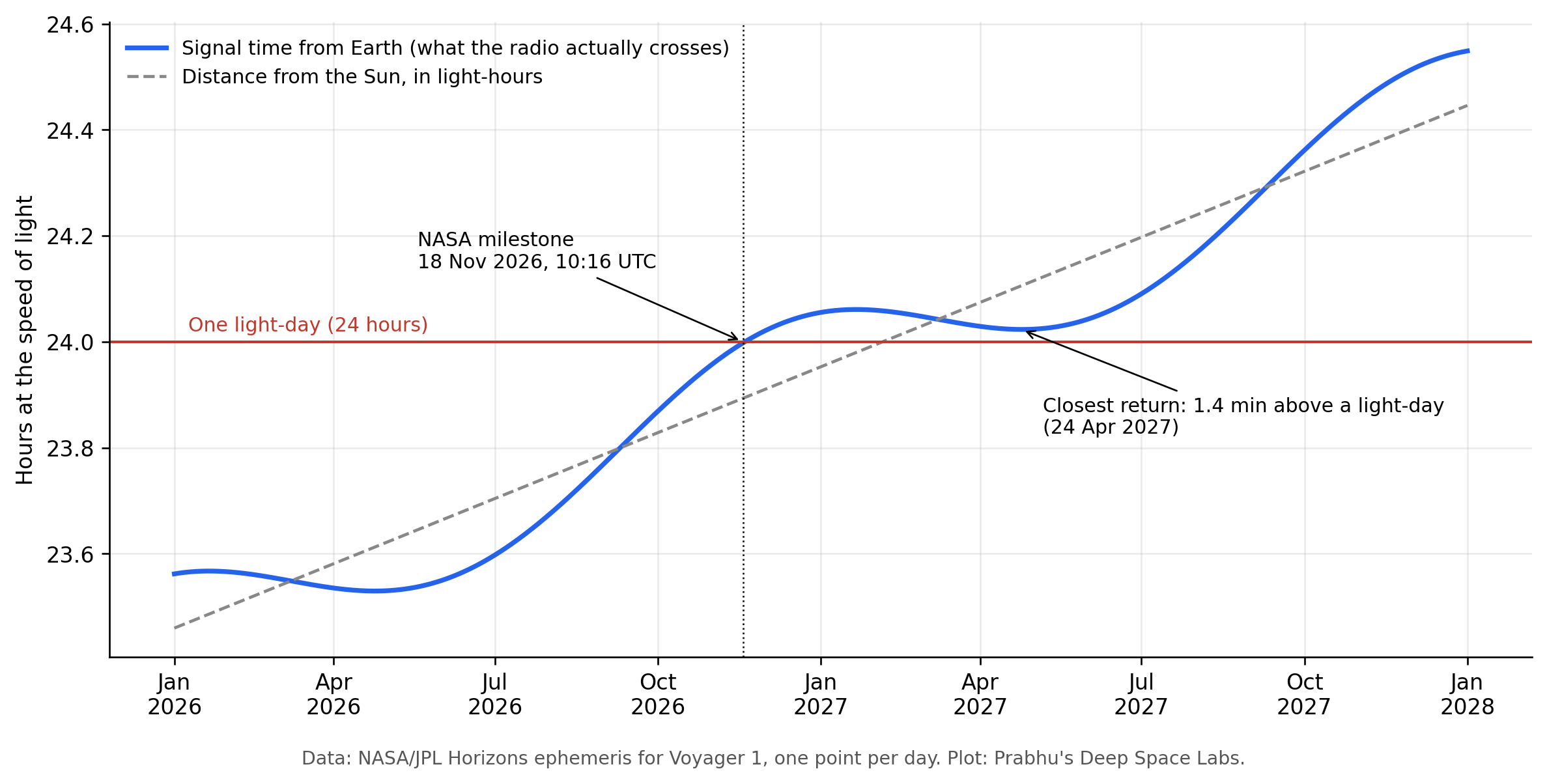
NASA gives the moment as 18 November 2026, 10:16:07 UTC. To see the milestone in context, I pulled a daily position for Voyager 1 from JPL Horizons, NASA’s own ephemeris service, for 2026 and 2027.
1. Measured from the Sun, it isn’t there yet
The milestone is measured from Earth. Right now Earth is on the far side of the Sun from Voyager 1, which adds about three-quarters of an astronomical unit to the gap. Measured from the Sun, Voyager 1 does not reach one light-day until about 4 February 2027.
2. Once crossed, never crossed back, by 1.4 minutes
Earth circles the Sun faster than Voyager is leaving, so for a few months each year the distance actually shrinks; NASA notes its own distance counters sometimes run backwards. After November, Earth swings back toward Voyager’s side, and on 24 April 2027 the signal time bottoms out at 1,441.4 minutes, just 1.4 minutes more than a full day. Then it climbs for good. The line is crossed once, with almost nothing to spare.
3. Earth hears it the next day
NASA’s moment is the instant the distance between Earth and Voyager equals one light-day. A radio signal, though, spends a day in flight while Earth keeps moving. The first signals that take a full 24 hours to arrive reach Earth around 02:18 UTC on 19 November. The milestone happens on the 18th. We hear about it on the 19th, from where Voyager was.
Nothing changes for the spacecraft. NASA expects Voyager 1 to detect nothing as it passes the line. The significance is ours: a measure of how far a machine built in the 1970s has carried us, and how patient you have to be to talk to it.
The same milestone is 18 November, 19 November or 4 February, depending on whether you measure the gap, the signal, or the distance from the Sun. None of those dates is wrong. They answer different questions.
When you announce a milestone, say what it is measured against. A number without its frame of reference invites three people to report three different dates and all be right.
How this was checked
- Data. JPL Horizons ephemeris for Voyager 1 (target −31), seen from Earth’s centre, one point per day from January 2026 to January 2028: distance from the Sun, distance from Earth, and one-way light-time. The data and script are in the voyager1-analysis repository (
voyager1_light_day.py), so anyone can re-run it. - NASA’s date. 18 November 2026, 10:16:07 UTC (5:16:07 a.m. EST), from NASA’s light-day page.
- This site’s own numbers. The distance and light-time on /facts come from a simple linear model, now corrected for Earth’s position. It agrees with Horizons to within about 0.15 astronomical units, a little over a minute of light-time.
Sources
- NASA. What Is a Light-Day? science.nasa.gov
- NASA (29 Oct 2026). NASA’s Voyager 1 Conserves Power, Resolves Brief Communications Pause. science.nasa.gov
- NASA. Voyager Frequently Asked Questions (distance counters running backwards). science.nasa.gov
- NASA/JPL Solar System Dynamics. Horizons System. ssd.jpl.nasa.gov/horizons
Read the full mission narrative in The Voyager Story.