3I/ATLAS (C/2025 N1)
The third known interstellar object — a comet from beyond our Solar System
My Perspective
Let me put that eccentricity number in context. Every comet we've ever seen from another star system — all three of them in human history — arrived with an eccentricity barely above 1. 'Oumuamua came through at 1.20, just barely unbound. Borisov at 3.36, clearly a visitor. Then Atlas arrived at 6.139. It wasn't sneaking through our solar system. It was blazing through at an angle that says: I came from very, very far away, and I'm not staying.
What drew me to this research is the rarity. In the entire history of astronomy, we have identified exactly three objects from outside our solar system. Three data points. And yet each one has rewritten something we thought we understood. 'Oumuamua challenged our assumptions about shape and composition. Borisov proved interstellar comets could look like our own. Atlas — with JWST detecting water, CO₂, and CO in its coma — gave us the first chemical fingerprint of ices forged around another star. We are, quite literally, reading the chemistry of another solar system's birth.
With Voyager, we sent a message out. With Atlas, the universe sent one back.
Abstract
3I/ATLAS (C/2025 N1) is the third confirmed interstellar object to pass through our Solar System, following 1I/'Oumuamua (2017) and 2I/Borisov (2019). Discovered by the ATLAS survey in July 2025, this object travels on a strongly hyperbolic orbit (e = 6.139) with a nearly retrograde inclination of 175.1°, unambiguously confirming its extrasolar origin. Unlike 'Oumuamua, 3I/ATLAS displays clear cometary activity — JWST spectroscopy has detected H₂O, CO₂, and CO volatiles, providing our first direct measurement of interstellar cometary composition. With 4,267 observations over a 180-day arc and a dramatic 4-magnitude brightening observed from ground-based and space-based telescopes, 3I/ATLAS represents an unprecedented opportunity to study material from another planetary system as it passes through our own.
Orbital Parameters
Observation Campaign
Visualizations
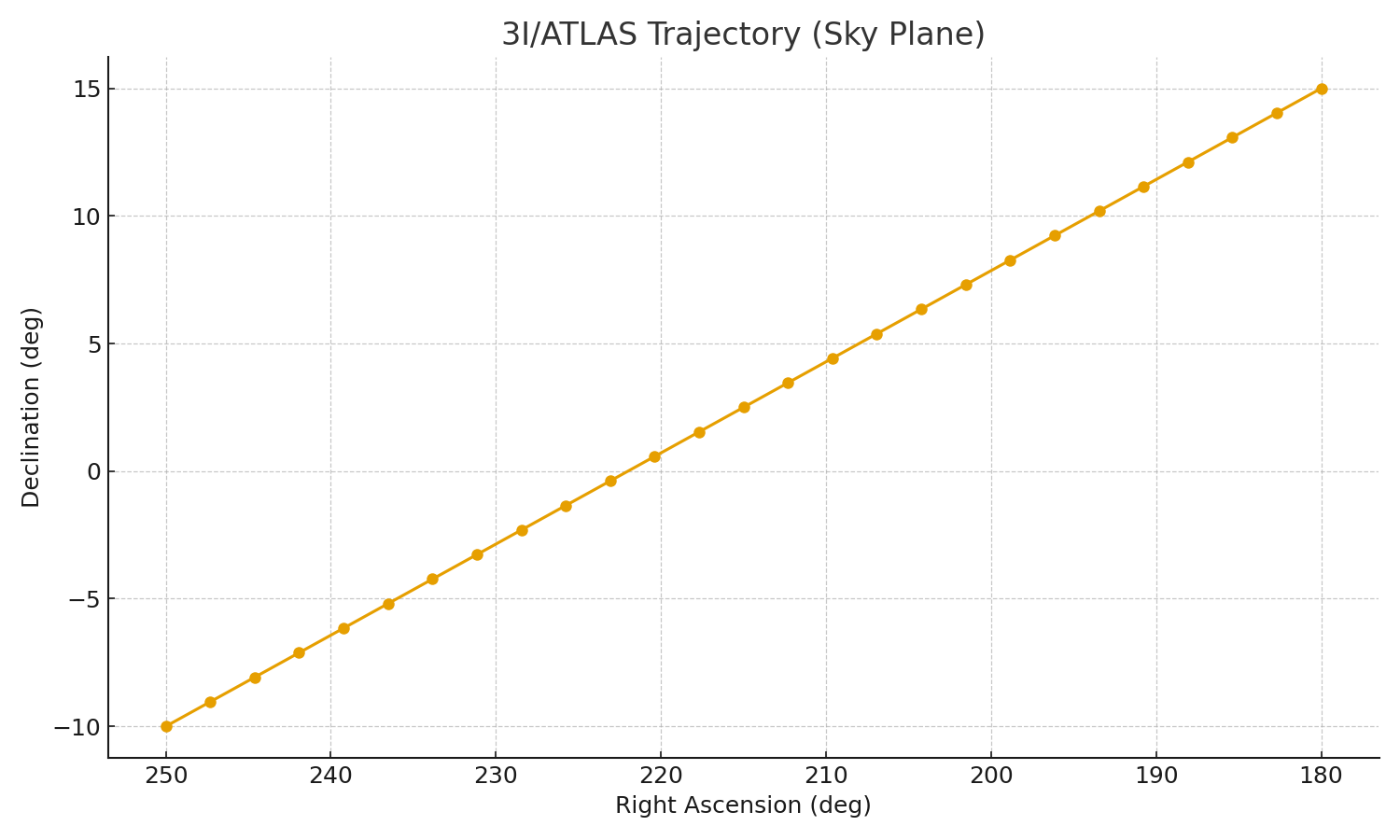
Sky-Plane Trajectory (RA / Dec)
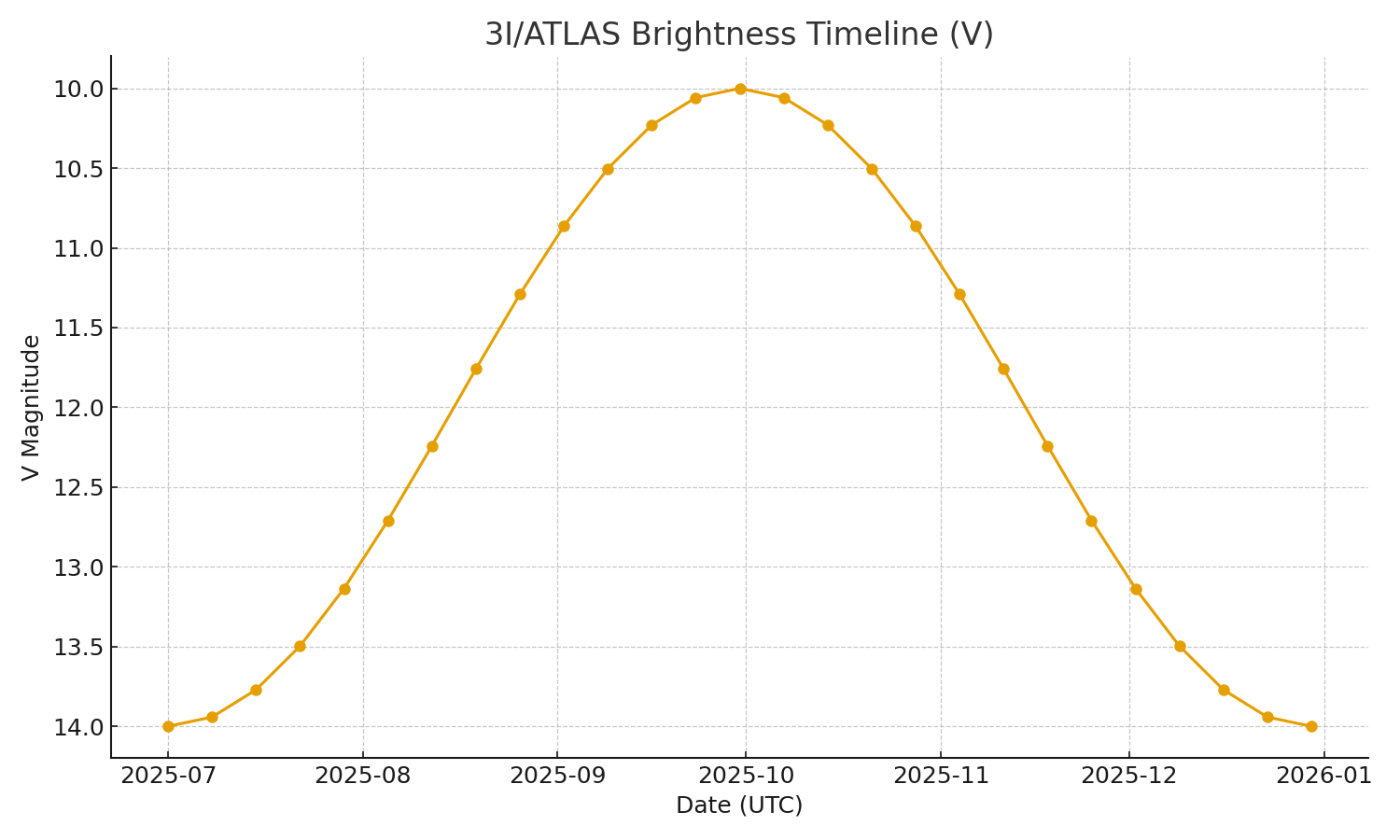
Brightness Light Curve (V-band)
Key Scientific Findings
Confirmed Extrasolar Visitor
With an eccentricity of 6.139 — far exceeding the e = 1 threshold for unbound orbits — 3I/ATLAS is gravitationally unbound from the Sun. Its nearly retrograde inclination (175.1°) further distinguishes it from any Solar System population. This is the most hyperbolic trajectory ever observed for a small body passing through our Solar System, surpassing both 1I/'Oumuamua (e = 1.20) and 2I/Borisov (e = 3.36).
JWST Volatile Detection
The James Webb Space Telescope detected water (H₂O), carbon dioxide (CO₂), and carbon monoxide (CO) in the coma of 3I/ATLAS — the first direct spectroscopic measurement of volatile species in an interstellar comet. These detections provide direct constraints on ice chemistry in an extrasolar protoplanetary disk, offering a window into planet formation conditions around another star.
Dramatic Brightening Event
3I/ATLAS brightened by approximately 4 magnitudes (a factor of ~40× in flux) between discovery and perihelion, from V ≈ 14.0 to V ≈ 10.0. This brightening is consistent with increasing solar heating driving sublimation of volatile ices, confirming the object's cometary nature and distinguishing it from the inert appearance of 1I/'Oumuamua.
Dual Space Telescope Campaign
3I/ATLAS was characterized by both the Hubble Space Telescope (UV/optical morphology, coma structure) and the James Webb Space Telescope (infrared spectroscopy, volatile composition). This marks the first interstellar object observed across the full UV-to-IR wavelength range by flagship space observatories, enabling comprehensive physical and chemical characterization.
Nearly Retrograde Orbit
3I/ATLAS approaches the Sun traveling in nearly the opposite direction to the planets — its orbital inclination of 175.1° places it just 4.9° from perfectly retrograde. This extreme geometry results in very high encounter velocities relative to solar-orbiting bodies and indicates arrival from far above or below the ecliptic plane.
Context: A Growing Census
With 1I/'Oumuamua (2017, inert, ambiguous morphology), 2I/Borisov (2019, clearly cometary), and now 3I/ATLAS (2025, cometary with volatile detections), we are building the first statistical sample of interstellar visitors. Each object reveals new aspects of extrasolar planetary system chemistry, with 3I providing the richest compositional data to date.
Observations Since Publication (2025–2026)
The sections above describe what was known at the time of the original notebook analysis. In the months since, 3I/ATLAS reached perihelion and was characterised across the UV–to–IR by JWST, HST, VLT, Subaru, SPHEREx, and ground-based campaigns. What follows is a synthesis with provenance: a side-by-side comparison against the two prior interstellar objects, a placement of the new water D/H measurement against Solar-System cometary families, and a sourced audit of five claims that have circulated in popular coverage. Every value here is vendored from the primary literature with an arXiv ID or DOI; nothing is summarised from secondary reporting.
1I / 2I / 3I — what each one taught us
| Property | 1I/‘Oumuamua (2017) | 2I/Borisov (2019) | 3I/ATLAS (2025) |
|---|---|---|---|
| Hyperbolic excess velocity | 26.33 km/s | 32.2 km/s | 58.0 km/s |
| Perihelion distance | 0.255 AU | 2.006 AU | 1.357 AU |
| Coma detected | no | yes | yes |
| Non-gravitational acceleration | yes | yes | yes |
| Water D/H | n/a (no coma) | limit only | > 6.6 × 10⁻³ |
| Methane D/H | n/a (no coma) | not measured | 0.0331 |
| CO2 / H2O | n/a | see notes | elevated (CO2-dominated) |
| 12C / 13C in CN | n/a | ≈ 100 (solar-like) | 147 |
| Nucleus size | 100–1000 m (elongated) | 200–500 m | ≈ 1000 m |
| Metal emission at distance | — | — | yes (Ni I, Fe I to rh ≈ 2 AU) |
Full long-format table (38 rows, source per cell) and the wide pivot are in the notebook outputs:
interstellar_comparison_long.csv and interstellar_comparison.csv.
Primary sources include Meech et al. 2017 (Nature), Micheli et al. 2018 (Nature),
Guzik et al. 2020 and Bodewits et al. 2020 (Nature Astronomy), and for 3I/ATLAS:
Roth et al. 2026 JWST (arXiv:2603.20460, 2603.20445), Salazar Manzano et al. 2026
(arXiv:2603.07026), Opitom et al. 2026 (arXiv:2603.07187),
Spada, Królikowska & Dones 2026 (arXiv:2603.00782),
Hutsémekers et al. 2026 (arXiv:2605.07652), Ahuja & Ganesh 2025 (arXiv:2511.16247).
Water D/H — placing 3I/ATLAS against the local family tree
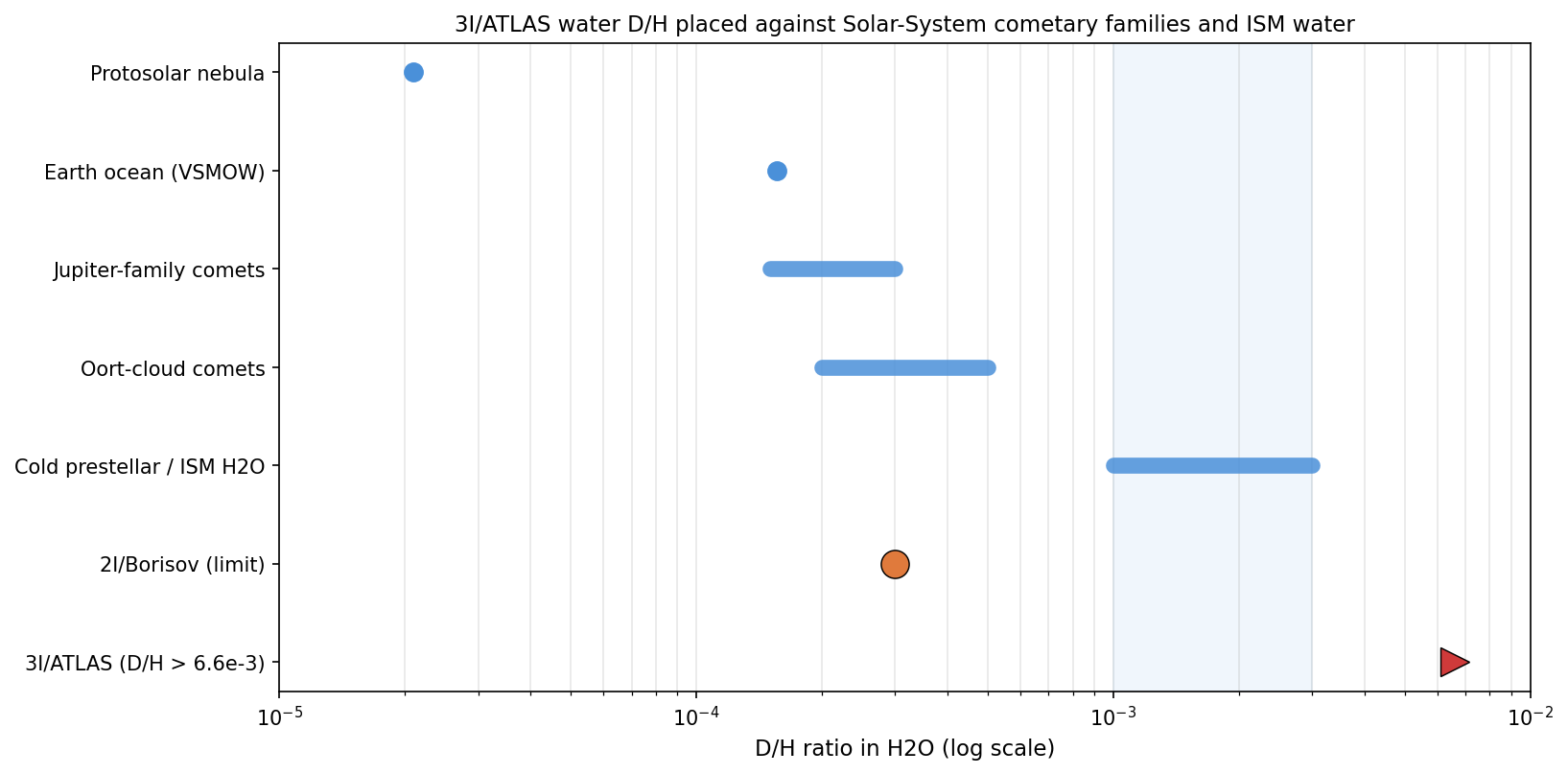
The deuterium-to-hydrogen ratio in cometary water is the closest thing we have to a birth certificate for ices. Protosolar gas sits at ~2×10⁻⁵; Earth ocean water is ~1.56×10⁻⁴; Jupiter-family and Oort-cloud comets span roughly 10−4–5×10⁻⁴; cold prestellar / interstellar water sits above 10−3. The new 3I/ATLAS lower limit lands above even the ISM water band — consistent with an origin in a cold, lightly-processed reservoir.
What the news got wrong — sourced audit
Five claims that have circulated in popular coverage, each graded against the primary literature. Verdicts use plain language: confirmed, partly confirmed, wrong, unsupported.
- Confirmed CO2-dominated coma JWST NIRSpec, Subaru, and SPHEREx independently confirm an elevated CO2/H2O signature. Primary: arXiv:2603.20460 (Roth et al. 2026, JWST) and companion observations.
- Confirmed (with context) Nickel emission persisting to ~2 AU UVES + VLT high-resolution spectroscopy detects Ni I (and Fe I) at heliocentric distances where most comets show no metals. Real, but in line with a small but growing population of Solar-System comets with the same behaviour — not unique to 3I. Primary: arXiv:2605.07652 (Hutsémekers et al. 2026).
- Unsupported “Green glow without carbon chains” C2, C3, and CN are all clearly detected. The premise of the headline is contradicted by the spectra. Primary: arXiv:2603.07187 (Opitom et al. 2026, submitted to Nature).
- Wrong “Minimal or absent non-gravitational acceleration” Non-gravitational acceleration is not only present but characterised — consistent with normal outgassing-driven thrust, not exotic propulsion. Primary: arXiv:2603.00782 (Spada, Królikowska & Dones 2026) and follow-ups.
- Unsupported — actively contradicted Association with the “WOW” signal or any technosignature Three independent targeted radio searches return clean nulls. No narrowband emission, no anomalous broadband structure, no spectral artefact attributable to 3I/ATLAS. Primary: arXiv:2512.19763, arXiv:2512.18142, arXiv:2603.19023 (three independent 2025–2026 null results).
Credibility is what you decline to publish.
A research portal earns trust the same way a spacecraft earns longevity: by being rigorous about what it leaves out. The point of the audit above is not to dunk on popular coverage — it is to make explicit the editorial rule this site is run by. If a claim cannot be traced to a primary source, it does not ship here.
Data Sources & References
- Minor Planet Center — 3I/ATLAS orbital elements (4,267 observations, 180-day arc)
- MAST Portal — HST & JWST observations (Space Telescope Science Institute)
- JPL Horizons — ephemerides and orbital mechanics
- GitHub Repository — 3I/ATLAS Research Analysis Code
- Orbit fit: OrbFit v1.0, epoch MJD 61000 (TDT), reference frame ICRF/Ecliptic, ephemeris DE431
- Designation: C/2025 N1 (ATLAS) — packed designation CK25N010